9/25/2011

無花果豆腐 Mousse


Time flies..... my last blog entry was 20 days ago!!!!  What have I done in the past 20 days?  Running house chores, got worn out by 2 monsters, just the usual stuff I guessed.  

Being a pro-C9, one of my very important duty is to make sure no single scrap of food is wasted.  I checked my fridge and found an almost expiring load of tofu, a box of figs and was thinking what should I do with them.


Somehow, both ingredients reminded me of my dad.  Figs being one of his favorite fruits, and tofu being a kind of liquid food that he could eat in his final days. Sour and bitter memories gushed out and I so automatically prepared this fluid diet tailored to dad's diet.

The upper layer was walnut and fig mousse seasoned with dad's favorite Cantonese steam fish soya sauce.  The bottom was simple tofu mousse.  In my mind, I only had one purpose, hoping dad could eat this because he had swallowing difficulties.

Tears just rolled down from my cheek for no reasons (苦笑).  Already 4.5 years, the pain got lessened but not gone.  Yup, 女人都是水做的・・・・・・・
  
 Should I spoon a mouthful in his mouth?  Did you like it dad? Sigh...........


That was the past and I still have a long journey ahead of me.  Put the past behind and look into the future.  Life is tough but I can make it through.

9/04/2011

Morning Sickness 孕吐 害喜 惡阻 薬膳食譜 Recipes

Thinking back of my 2 pregnancies.... I was quite fortunate that I didn't have any "major" morning sickness, but, there was still discomfort during my first trimester.  I didn't feel like eating a "certain" kind of things, I wanted to eat "junk food", KFC, MacDonalds, etc....  Some smells would knock me out totally, such as kerosine stove smell.  My taste buds were not like mine, it was a strange weird feeling.

My very early memories of "What to eat when you have morning sickness" dated back to those 1980s HK TV dramas.  The story lines were very straight forward and simple.  In 9 out of 10 scenarios, it would be a young lady got pregnant by accident and felt nausea, showing signs of vomiting, wanting to eat "sour" things such as preserved lemons (鹹檸檬) and dried plums (話梅)!  Then, people around her starting to suspect what's happening and she would be so stressed out and lost, crying badly, having no way out and was trying to end her pregnancy by eating watermelon (西瓜)!

ha ha ha.... that was really an outdated image of accidental pregnancy before marriage.  Nowadays, if you got pregnant by accident, especially in Japan, people will say, "congratulations to you!!!" (おめでとうございます!!!) because no one wants to give birth anymore and it is such a great and happy event that finally someone is pregnant!  It is no longer a shameful event (at least in Japan) that you got pregnant before marriage.  I wonder what is it like in HK now. However, please don't get me wrong, I still believe the orthodox way, meaning babies should come after proper marriages!!!!  ha ha ha... I am an old lady!

A lot of ladies will change their taste and found a "certain" food intolerable.  Below may be some remedies, but I have no guarantee that it will work on everyone as each person is different.

The reason for having morning sickness in Chinese herbalist's point of view is because pregnant woman's strength and health got weaken, the "chi" (気) in her body can't flow properly, so it will upset its stomach hence losing appetite. 

Lemon Chicken (檸檬鶏):

Lemon (檸檬).  Lemon can not only quench your thirst, it also can help to alleviate morning sickness.  檸檬性溫、味苦、無毒。 中醫認為檸檬可以止渴生津、祛暑清熱、安胎、疏滯、化痰、止咳、健胃健脾、止痛、殺菌等功能。 No wonder those old HK TV dramas mentioned about eating "lemon" at the early stage of pregnancy.

Function: 醒脾和胃補中益気

Chicken fillet: 1 piece (200g) or pork (no beef please.... or you can use pigeon or quail!!! ha ha ha who will bother to fillet such tiny bird...!!!)
Salt 1/4 tea spoon (Not too salty for pregnant women....)
1/2 egg
Corn starch
Onion 1/3, sliced it.

Lemon sauce:
Fresh lemon 1/2 juice it.
Lemon peels (try to get an organic lemon), finely chopped it.
Chicken broth 1/2 cup
Soya sauce 1.5 tea spoon (not too salty for pregnant women and if the chicken broth has salt in it already, you may wish to reduce the amount of soya sauce)
Brown sugar 1.5 tea spoon
Corn starch to thicken the sauce

Recipe:
1. Slit the chicken fillet slightly on the meat side.
2. Rub the salt all over the fillet.
3. Dip the fillet into the whisked egg then coat it with corn starch, remove excess starch.
4. Heat up a non-stick fry pan or wok, add a table spoon of oil, swirl it all around the pan, then place the chicken (skin down) over medium to high heat for about 3 minutes, chicken oil will come out, then turn the fire to low, slowly pan fry the fillet until all the oil comes out, use kitchen towel to absorb the excess oil, turn the fillet over and cook it until done.  Make sure to absorb the OIL!!!

Sauce:
1.  Heat a table spoon of oil over a non-stick pan or wok.
2.  Fry the sliced onion until clear.
3.  Add the lemon juice, lemon peel, chicken broth, soya sauce, sugar and bring it to boil.
4.  Then thicken the sauce with corn starch liquid.
5.  Taste it but I strong recommend "mild taste" meaning not too salty for pregnant women.
6.  Pour the sauce over the chicken fillet.

(Example)

Sweet and sour minced pork with cold noodles (糖醋肉碎冷麵):

This is really not a good picture because during pregnancy, we should avoid eggplants.  That's because a pregnant woman should avoid eating 通経、去瘀 food, meaning food that can boost the blood circulation.  Eggplant's cooling and "blood cleaning" nature is definitely not ideal for pregnant women, so please don't eat if you are expecting although each person is different, some people eat it and nothing will happen, just to play safe, try to avoid it.

The sour taste of the pork will increase your appetite and the Shiso (紫蘇) can help to ease the morning sickness discomfort as it can ease the stomach upset plus cease vomiting.

Function: 醒脾和中

Minced pork 200 g.
Minced ginger, 1 tea spoon.
Minced spring onion (white part root area only 葱白), 1 tea spoon.

Sauce:
Zhang Gong Vinegar (鎮江醋) 1 table spoon
Soya sauce 1 table spoon
Brown sugar 2.5 tea spoon
Rice wine 1 tablespoon
Water 50cc


Heat up 1.5 tablespoon of oil to the wok or fry pan over medium heat, fry the minced ginger and spring onions, then add the ground pork.  When the pork has changed its color to white, add the sauce and cooked until the meat sauce is dried up with a shine.


Boil the cold noodles until soft, mix it with the meat sauce and cut up some fresh Shiso (紫蘇 ) then mix the noodles well to serve.


(Example)

Just to be frank, when I was pregnant with my 2 girls, I ate whatever I felt like and had no taboo on any what-so-ever "food"!

I had eggplants, watermelons, bitter melons, etc... all those considered to be too "cooling" to pregnant women; chili sauce, deep fried, those considered to be too "heating" to pregnant women; tea and coffee, those considered to be too "stimulating" to pregnant women.........  I had them all!  I guess, my body was OK enough to sustain all these external bad influences to pregnant women.

Yet, one thing for sure, when I was pregnant, I felt tired very easily.  No stamina to stand up cooking a feast to myself.  I bet there are thousands and millions of people who share this with me, when you don't feel like doing anything, just make a cup of tea to relax!


Cardamon Lemon Tea:

If you feel like your stomach is filled with gas, not wanting to eat, burps a lot, try this tea.  Cardamon is something similar to 砂仁 in Chinese herbs except it is "raw" not "processed".  Meaning it is really mild.  The processed Cardamon will be 砂仁.  砂仁 can alleviate morning sickness as well as stabilize your fetus.

2 Cardamon, crush it.
1 slice of lemon
1 slice of ginger


From my experience, the key point is to "relax" and "enjoy" your pregnancy.  The baby will come out much sooner than what you think!

9/01/2011

灣仔街市 Wanchai Wet Market @ HONG KONG

As I told you, I love market shopping. It was a very enjoyable activity that my grandma and father taught me. I accompanied them to Fa Yuen Street's (花園街街市) wet market since the age of 5 or even earlier? My childhood memories all resembled around Fa Yuen Street......

Recently, a childhood friend of my sister asked me why was I always absent from home during their play dates? My quick answer was, "Perhaps I went shopping with grandma!"

(A veggie store along the Wanchai Market street. Lots of varieties and lots of green leafy vegetables. I can't get this variety in Japan. I bought 紅莧菜 (sorry don't know its English name) home. Very similar to cranberry, 紅莧菜 can do the following, 清熱解毒、補血止血、利尿去濕, 清腫止痢, so it is very good for summer. It is especially good for urethritis (尿道炎)).


Sniff, sniff, dad will point at a few durians and get the guy to "smell" for us. Dad will stuff a piece of those freshly cut durians into my mouth for tasting prior to purchase. Those Dai Pai Dong with green wooden panels and highly hung up benches where "men" sat down for a cup of HK Naai Cha (港式奶茶 HK style white tea). Those hawkers pushing their "transparent" trolleys with rice cakes in a small soup bowl, But Jai Gou (砵仔糕 ) in brown and white colors...... etc.... the hustle and bustle of a typical HK morning at the market background with mega hertz noise..... those were my childhood memories.

Durians have its new look in HK. The Golden Pillow (金枕頭) from Thai was my dad's favorite back in the old days. Now, you can find Imperial Cat Mountain (貓山王) or D24 (yup, it is D24 not 24 K gold!) from Malaysia. Both were new names to me. I have no idea what their real English interpretation should be so please bear with me, my very own literal translation.

If you want something different, try 醉榴香榴槤冰皮月餅 (Tsui Lau Heung Durian Snow Skin Moon Cakes) or try Top Milk durian ice-cream, or even durian crepe from one of those local sweet stall, etc... All these are new products that HK people love. Mum was very happy that she had her full "YEAR" portion of durian this summer.  I am losing count on how much durian she has eaten this year.

(I bought a piece of 扁膠魚, 鰆 in Japanese and made 塩焼き魚, grilled fish).


(The price of pork has soared so badly in HK that how can pheasants afford? I talked to my foodie friend and said they would have to compromise with the cheaper frozen meat meaning the "standard" of their taste buds will be degraded as they don't know the real taste of fresh pork).

When my daughters walked pass the butcher, she pointed at the pig head and said, "Mummy, pig head!!!! Look! The pig tail is dangling here, too!"...... I said to her, "What's the big deal! You haven't seen the more exciting stuff! Your Gung Gung (公公) used to take me to the "dark" side of the market..... something even more exhilarating! "... ha ha ha... didn't dare to tell her what I saw when I was a kid!


(They Lychee season was coming to an end and I didn't want to compromise to the leftover bunch, so I didn't purchase any).

Grandma used to get us a full bamboo load of lychee from her hometown (東莞). Whether it was 桂味 (Gui Mei) or 糯米糍 (Loh Mai Chee), the different types of lychee, I ate them with delight, leaving both hands so sticky from peeling the sweet juicy lychee non-stopped. Grandma used to tell us "一顆荔枝三把火" meaning excessive intake of lychee will flame your body greatly (濕熱) .  E.g. sore throat, acne, headache, constipation, etc...) However, so far so good to me, I didn't seem to suffer from anything.

Then I found this very interesting shop where they sell fresh Chinese herbs. Normally, you can find "dried up" or "processed" Chinese herbs in a herbalist shop, the fresh ones are rarely seen. When I looked at what this shop offered, I spotted one point straight away. Most of the fresh herbs are for getting rid of excessive heat moist (濕熱) in your body. Hong Kong being part of the South Eastern part of China, I tend to call it Lingnan (嶺南) area, where the weather is always wet, humid and warm, we Southern inhabitants (南方人) suffers more heat moist (濕熱) problems such as diarrhea, constipation,  skin problems, etc... than the Northerners.  (濕熱), heat moist means all the toxins within our body should be passed out from our body by form of urination, sweating, and bowel, etc... if the toxin can't be passed out from our body and got stuck inside, then we sometimes call it moist heat. (濕熱)

These moist heat herbs are not commonly used in the Northern part of China due to the climate differences. Most of the herbalist teachers in Japan are from Northern part of China and they rarely mentioned those herbs that I normally eat when I was in HK. E.g., 野葛菜,土伏苓, etc...) All those are moist removing herbs that we use in Hong Kong.


I felt the great differences in the prescription between the South and the North.  南北之分.  Most of the Chinese prescriptions that I see in HK nowadays (mostly from my friends) are heat removing, detox prescription (清熱排毒去濕).  While in the old days, I saw more vitalizing prescriptions (補方).  I guess the reasons are because of 1.  The wet, humid HK weather.  2.  HK people enjoy too much good food nowadays that their body can't even sustain it.  So the herbalists nowadays focus of helping them to get rid of their toxin in their bodies than helping them to "add" more nutrition.  Perhaps we should stick to more simple, plain diet to balance our body in this contemporary society.

8/28/2011

花香菜脯沙葛粒 @ Home by "一碌葛"的我!


Life will not change no matter which part of planet I am in. The same old house chores to do: washing the mountain high laundry, shopping for food, cooking, vacuuming + moping the never clean floor, yelling "can you girls please clean up your mess" a thousand times, go to sleep NOW, etc.....

While I stayed at my mum's place during the last summer vacation, I worked as usual, and that's what I called, GREAT LIFE. Honestly, being able to "maintain" the same quality of livings across the globe can't be a better deal.


Yet, there is a difference. The food that you can find in the market has a distinctive difference. I love wet markets! I love to find things that I have never seen or eaten before. When I went to Wanchai market, my eyes were always screening for fresh and unique stuff, or things that I couldn't get in Japan.

This time, I spotted 沙葛 (Kudzu) and 夜香花 (Night Blooming Jasmine). In Japan, Kudzu are well used in many 和菓子 (Japanese cakes) such as 葛切り (Kudzu Kiri) or 葛餅 (Kudzu Mochi) where both turn the Kudzu gluten into some glutinous cakes. However, Night Jasmine is not so popular in Japan.

As the name says, Night Blooming Jasmine, so it blooms at night and closes during the day. At night, its sweet fragrance will be released as its name depicts.

Grandma used to cook winter melon soup where a bunch of Night Blooming Jasmine will be added to enhance its fragrance. Oh, how much I missed that.

As soon as I spotted Night Blooming Jasmine, my eyes widened. Pretty much liked how my younger daughter spotted an ice-cream shop where she would flap her hands up and down, yanking on my T-shirt or even rolling on the floor until she got one. Except that I am a fully grown up now and won't exercise my basic instincts to get what I want.

I asked for 2 taels, paid HKD $8, thought that was pretty cheap. Next thought, how much did grandma use to pay for it? That would be more than 30 years ago event and could anyone tell me?????????????????? Contented and my next challenge came up.

How should I cook it? Dump it into winter melon soup like grandma? Naah........ that would be too boring. So, I gave it a thought and considered the current weather, then came up with a bashing down the heat dish.

花香菜脯沙葛粒

Basically this dish contained of the following:

菜脯. Preserved white radish. Cooling vegetable.
Celery. Another cooling vegetable.
Carrot. Another cooling vegetable.
Kudzu. Another cooling vegetable.
Night Blooming Flower, a cooling flower, too.

So I concluded that this dish is a "summer" dish to cool down your body heat during the hot and humid HK summer. (My conclusion! ha ha ha...)

My dear dear sister gave it a look and asked, "So this white cubes are Kudzu.... hmm...." I believed she had never had it before.

She easily wrapped up her first bowl of rice then headed for her second refill. I asked in amazement, "You are having a second serve?". Why was I so bewildered? She is as skinny as a stick and I have never seen her refilling for rice.

My heart went a bit sour at that point. Poor thing must be missing home cooking badly or may be she was so badly fed by HK eateries....... This old Chinese saying popped up from my mind immediately, "若讓小兒安,三分飢與寒". So may be starving her a bit may not be a bad thing though! Wahh Kaaa Kaaa............ (What kind of sister am I!!!!! ha ha ha... ke ke ke...).

After I wrote this article, a "foodie" friend (she is a REAL food pro) told me, "do you mean 沙葛 instead of 粉葛" as I wrote "粉葛" in the beginning. That shone light over my head as I only had "粉葛" in my mind but what I really meant was "沙葛". The reason being, I only thought about the medicinal purpose of Kudzu where all Kudzu have similar healing functions, yet, different types of Kudzu offers different textures in taste.

I have to say, I am such a "一碌葛" (meaning a piece of Kudzu). Why? Cantonese is a very interesting language where it uses heaps of objects to describe a certain kind of behavior or person. Especially when it comes to "swearing words". For example, if someone says you are a piece of Kudzu "一碌葛", that means you have no response and non-alert. Just like me, I always think I am a huge piece of 葛根, day dreaming all day.

When I wrote this blog, all I had in my mind was Kudzu roots as (葛根), its cooling function that is suitable in summer as well as good to people with high blood pressure. Its (辛涼解表) (
cold-pungent diaphoresis) function can help to reduce fever. It can also reduce neck pain and stop diarrhea, etc... I kept thinking 葛根湯's 葛, where it was made from the white powdery Kudzu "粉葛".

Thanks to her, it woke me up from my dream. Wake up Wake up, Tokyo C9!!! In HK, there are 2 common Kudzu roots (葛根)。 

1. Powdery Kudzu (粉葛) where it is a long cylindrical shape root. As its name depicts, it is very powdery. Yet, it has more fiber and not that crunchy. We Cantonese normally use it for soup.

2. Sand Kudzu (沙葛) where it is a fusiform shape root. Its skin can be easily peeled off leaving its snowy white root. Very juicy and crunchy. We normally use this Kudzu root for stir-fry.

Although both Powdery Kudzu (粉葛) and Sand Kudzu (沙葛)are of the same Kudzu root (葛根) family with similar medicinal functions, its texture differs greatly.

I sincerely thank my professional foodie friend pointing this out and please let me know if there's any "weird" or not making sense stuff in my blog going forward! I normally type out in the middle of night where my brain only half functions leaving lots of spelling, expressions, faulty content stuff, etc... ha ha ha.... The main thing is continuity. I want to jot down what my family taught me so I can pass on these words to the next generation. C9, ADD OIL!

8/24/2011

感恩 Dinner.... @ Home

March 11 2011 marked a very special day in my life. I have always thought my life is rather unique as compared to my other siblings. Yet, this event made my life even more unique as not too many people would have had the same experience as me.

Lots of dear friends and relatives offered their kindness and support to me during this very harsh time in my life. In Chinese medicine theory, when you are in fear (驚恐)your emotion will be greatly disturbed (亂). 

From : 『黄帝内経』 『素問』「拳痛論」七情傷気
百病生於気也。怒則気上、喜則気緩。悲則気消、恐則気下。寒則気収、炅則気泄。驚則気乱、労則気耗、思則気結。九気不同、何病之生。岐伯曰、怒則 気逆、甚則嘔血及飧泄、故気上矣。喜則気和志達、栄衛通利、故気緩矣。悲則心系急、肺布葉拳。而上焦不通、栄衛不散。熱気在中、故気消矣。恐則精却、却則 上焦閉。閉則気還。還則下焦腸、故気不行矣。寒則腠理閉、気不行、故気収矣。炅則腠理開、栄衛通。汗大泄。驚則心無所倚、神無所帰。慮無所定。故気乱矣。 労則喘息汗出。外内皆越、故気耗矣。思則心有所存、神有所帰。正気留而不行、故気結矣。


That was exactly me.

To thank all those who had given me lots of care and support (and they are STILL continually supporting and caring for me!!!), there's hardly anything I could do to repay them. I could possibly treat them for a nice dinner but how much could I pay??? Everything is so expensive in HK nowadays! The only thing that I could do would be cooking up a very simple meal, just to show my appreciation.

I prepared much in advance knowing I wouldn't have the "manpower" to do anything at home. When I thought everything was "set", then C got microplasma the very next day we arrived HK. Running with a high fever and coughing non-stopped, I didn't dare to take the risk of having guests in the house.

However, it was a miracle that her fever rescinded the very next day and her condition was well under control to the extent that I believed I could manage to host my guests. With the drawback of worrying spreading the germs to other kids, I only asked my close relatives to come. I warned my sister in advance, "I don't bear any responsibility if your child gets sick!".

Yet, with great courage, she and her family came and we had our thanksgiving party on schedule. I sincerely apologize to those who couldn't attend this time. Let's plan again!!!


(Corn salad in Yuzu dressing with Botargo).


(My sister called this clam shooters! ha ha ha.... it is clam cooked in rice sake then hardened the jus with agar agar. I added 茗荷(a kind of onion looking herb), ginger, 穂紫蘇 and pickles mustard in it).


(昆布〆鯛の手毬寿司. The bream was marinated in rice vinegar then sandwiched with Konbu (Kelp). Lollipop sushi with vinegar marinated bream).

(C's dinner. Plain rice porridge! I got to say she knew what she could eat and not when she falls sick. She never complained about rice porridge whenever she felt sick).


(Salmon and avocado salad in exotic Thai dressing).


(中勢以's aged beef RARE roast beef. I made this very rare, almost raw to "show-off" the genuine taste of this beef).


(Steamed chicken with homemade clam sauce. I am Chinese and steamed chicken is a MUST for me! ha ha ha.... 大魚大肉!)


(Very simple pan fried 中勢以 aged beef sirloin steak).

(畳鰯 sandwich. Tatami Iwashi means baby sardine flattened sheets. The filling was potato salad with smoked salmon topping).

(Foie Gras Flower! My sister commented that the "flower" was not that easy to eat so I modified this idea into something else for my next "foie gras" attempt. Yup, I love foie gras, livers and anything that can lead to high blood pressure, high cholesterol and 高脂血症! Life is short and enjoy when you still can).


(Mr. Yim's birthday cake. My sister paid for this black forest cake. Hoping I will get a cake in return on my b'day.... that was a 妄想! Which I should have known better......).

8/05/2011

龍璽 Dragon Zeal

"A million dollar night view" (百万ドルの夜景) as the Japanese always said so to the glittering Hong Kong neo-lights shone sky. Yet, going out at night still poses some difficulty to me and I always have to compromise to daytime outings.


(You don't get a view like this in any toilet)

(Fine bone china from Nikko. Impressive.)

A while ago, I was priviledged to dine at "Dragon Zeal" located on the 101th floor of the newly erected high-rise, ICC. A friend of mine told me it belongs to Dragon King Restaurant Group (龍皇) and they charge a premium for its location.

I thought to myself, being a tourist, I should try this out and to enjoy the splendid view on a sunny day. I made the right decision on the right day!

(Another breathtaking view)

How "rich" or "wealthy" a country is can be seen from the quality of the Dim Sum a restaurant offers. Modern Dim Sum has its new look where a simple stable "Siu Mai" (焼賣) ought to have a thin slice of abalone topping and the "Ha Gao" (蝦餃) got to has a thin film of gold paper on top. Is it really necessary? Not to me, but to appeal itself as a high-end restaurant, perhaps it is essential.

(龍璽焼賣皇 HKD$70)
Steamed Pork Dumpling Dragon Seal Style

Yup, it was the taste of our traditional "Siu Mai" and with the thin slice of abalone topping, the restaurant could charge an extra $40. Honestly, with or without it, it didn't make much difference to me but it was steaming hot and fresh prawns were used. So, it was OK in $$$ terms even to this budget tight C9.

(澳洲石蠔春卷 HKD$70)
Deep fried spring roll with Australian Rock Oyster

Another steamy hot dish but I could hardly taste the oysters. Shredded pork and yellow Chinese chives were prominent and I guessed the oyster were so finely chopped that its existence went under par after various seasonings were added.

(老爺子古法鬆糕 HK$55)
Steamed sponge cake

The name arose my curiosity. I could understand that part "古法鬆糕" meaning sponge caked made in the orthodox school method. Probably it didn't use the modern "blowing up" method where baking powder was commonly used, and instead, it used the traditional "natural yeast". Yet the first part of the name, "老爺子" (grandpa) made me puzzled for a while. Why old grandpa recipe sponge cake? Regardless of all, thumb up for its great taste! Spongy yet moist and not too sweet. Good stuff. However, $55 is a bit price-cy to me!


(雪影叉燒飽 HKD$60)
Baked BBQ pork buns

Hot Hot Hot....!!! Very well done!


(立方荔芋盒 HKD$65)
Deep fried taro cubes

You may have realized that I ordered lots of "deep fried" dim sums because my mum was not with me and I could freely lift up all the "restrictions" imposed by her. ha ha ha....

Tell you a trick to make this. The oil temperature got to be around 160 to 170 so that the lard will melt and clump with the wheat gluten to come up with this "flaring" effect. If the temperature is too high, the whole thing will turn out to be a solid "ROCK"! (From my past experience! ha ha ha... meaning I had failed numerous time before knowing the trick.)

Want to try making this tomorrow.....

(黑松露老城炒飯 HKD$150)
Fried rice with seafood and black truffle

The taste was ordinary fried rice and the black truffle was almost non-noticeable. Yet, if you add "black truffle" on the menu, you can bump up the price of a plate of fried rice by 50%. Why not?

I had no complain about the service. Me and my girls were well pampered by all the surrounding staff which was a "rare" phenomenon in HK's service industry nowadays. It is really sad to see that HK restaurant or hotel service quality deteriorates by year. I was quite impressed by their well trained staff and their awareness of serving me "hot" food on a timely manner. Thank you.

7/13/2011

萬来亭 Banraitei at Chinatown, Yokohama

Hello, Tokyo C9..... welcome back to your blog!

I was so lucky that I got invited to this special Shanghainese lunch party a couple of months ago organized by a Chinese food lover. Thank you Mr. Luk Yu for inviting me.

In Japan, I can hardly eat "authentic" Chinese food and thanks to these bunch of Chinese food lovers, I can sometimes get the "real" taste.


涼拌毛豆青瓜
Shanghainese Edamae and cucumber salad (with a twist of garlic)
My dad's good friend (a Shanghaiese himself) always made this at his home party.


椒鹽鴨舌
Deep fried duck tongues
I loved its spiciness.


五香蠶豆
Fava beans blanched in star-anise broth
(I asked the chef for this recipe! Wahh kaa kaa, so typical of me.)


涼拌海蜇
Shanghainese jelly fish salad
Do you know jelly fish can help to reduce the flame in the lung?


八寶雞
Chicken stuffed with chestnut and cooked in soya sauce
I once cooked the whole chicken for my friends and it was left untouched at the end of the meal. I first thought Japanese don't eat chicken with bones, but I was wrong. For Chinese food lovers, they ate them without a 2nd thought!


紅燒雙筍
(春筍 + 茭白筍)
Spring bamboo shoot and wild rice bamboo
I love its crunchiness! A special spring treat!


蒸釀豆腐
Steam stuffed beancurd
This dish reminded me of my Chinese roots so badly. The roughly chopped ground pork was definitely something that I missed!


涼拌豆腐干
Shanghainese tofu salad
I quite liked it.
I licked the sauce long enough to analyze its content.... I think I got it.


薑葱蠶豆(火靠)大眼雞
Splendid Alfonsino cooked in fava beans soya sauce
A typical Shanghainese cooking where soya sauce reduction method was used.


花蛤蒸水蛋
Shanghainese steam eggs with clams
When this first came out, I thought it was 雲南氣鍋湯湯 SOUP!


And it turned out to be steam eggs with clams. The eggs were indeed a bit overly cooked, yet, the soup yielded was so sweet and full of clam flavors. I drank up all the soup leaving all the eggs behind.... when you reach up to my age, cholesterol has to be restricted!


餸飯配菜
I have no idea what it is but it seems like one of those preserved side dish good to accompany with rice. Next time, I will try to reproduce something similar.


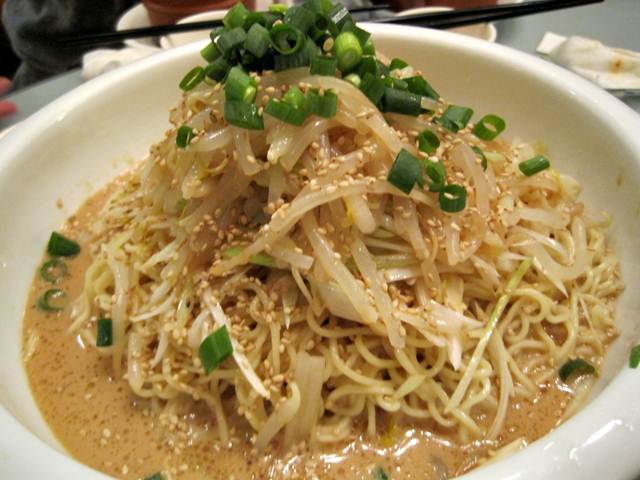
麻醤涼麺
Cold noodles wrapped in sesame sauce.
I have to say, this is one of my favorites. I always make it at home. Their sauce is a bit waterly but I loved their strong vinegar content. With bean sprouts, a MUST treat for summer.


Together with the shop's home made chili sauce, unbeatable.


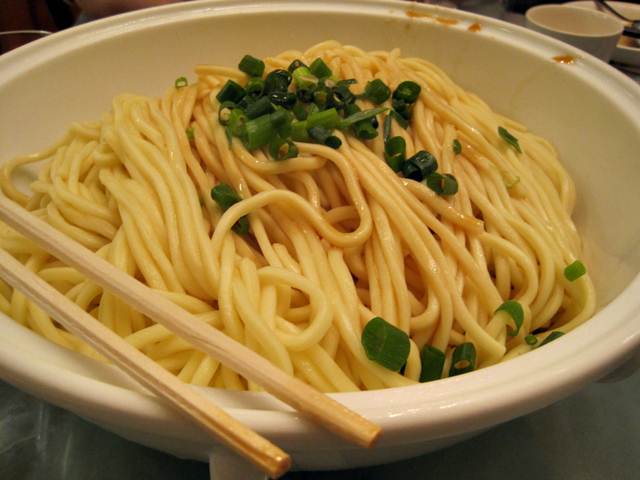
葱油麵
Non soup type noodles wrapped in spring onion oil sauce.
A specially ordered dish on site! Ghee, their noodles were great! Want to eat again.


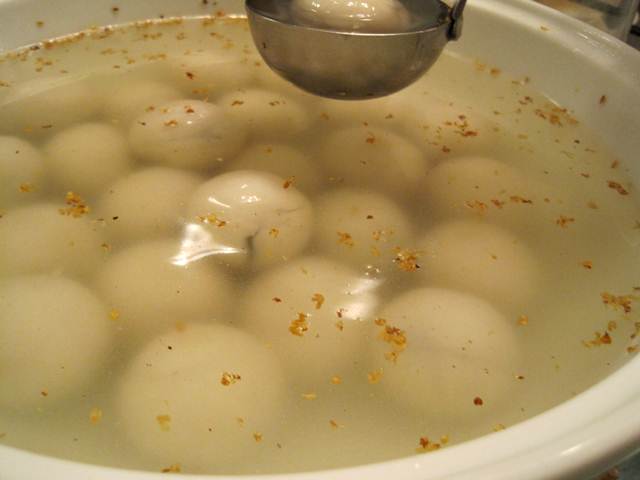
芝麻湯圓
Glutinous rice dumping filled with sweetened black sesame sauce.
This was one of my favorites, too!!! The black sesame stuffing was very well done. Sooth and silky and not too sweet.


Thanks again, I had a great meal!